
Washington County Projected Versus Actual Release
VADOC calls its public locator field Release Date. When that date is still in the future, it is best understood as projected because the calculation can change. The actual release is the completed custody event recorded after the person leaves that authority. A date on an incarcerated result is not proof that release has occurred, and a Parole Board grant is only an authorization stage before VADOC sets and completes release.
A Washington County pretrial detainee is different. No sentence has yet supplied a fixed end date. A bond order, dismissal, or other court action may authorize release, but SWVRJA still must process the event and resolve any holds. Transfer to another SWVRJA facility, VADOC, federal custody, or ICE is not community release. Read the JailTracker Release Date, Facility, Cases, Charges, and Holds fields together.
- Projected date
- A forward-looking date calculated from the sentence and credit information then on file.
- Actual release
- The completed departure recorded by the agency that held the person.
- Detainer
- A request or legal basis for another authority to take or continue custody.
- Jail credit
- Qualifying time already spent in confinement that is applied to the sentence computation.
Note: A court order can permit release before jail processing ends, while a hold can keep custody in place afterward.
Find Washington County Projected Release Dates
Start with jurisdiction. The VADOC Inmate and Supervisee Locator is the official public route for people under VADOC custody or supervision. Search by seven-digit DOC ID when possible, or by first and last name with optional location, race, gender, and age filters. Match more than a name. For an incarcerated state prisoner, read the exact Release Date label and note the day the search was performed.
- Identify the custodian. Use VADOC for a state sentence and SWVRJA plus the Washington court for a county jail episode.
- Search VADOC by DOC ID or full name. Compare identifiers and location before accepting the match.
- Record the displayed Release Date as a current projection if the person remains incarcerated.
- Review the sentencing order for active time, suspended time, jail credit, and concurrent or consecutive terms.
- Ask VADOC about state computation concerns, or ask SWVRJA and the court about a local sentence. Do not apply one system's formula to the other.
- Verify the event again near the date. Use the final custodian record to establish actual release.
VADOC says locator data are updated daily but can be inaccurate or outdated. A person fully discharged from both custody and supervision may fall outside the locator's described scope, so a no-result is not a historical discharge record. A county-jail-only detainee may never enter VADOC at all. For an older event, use the court file and the record request paths described on the Washington County release-record search.
The official VADOC locator source shows the search route used for state release-date lookup.
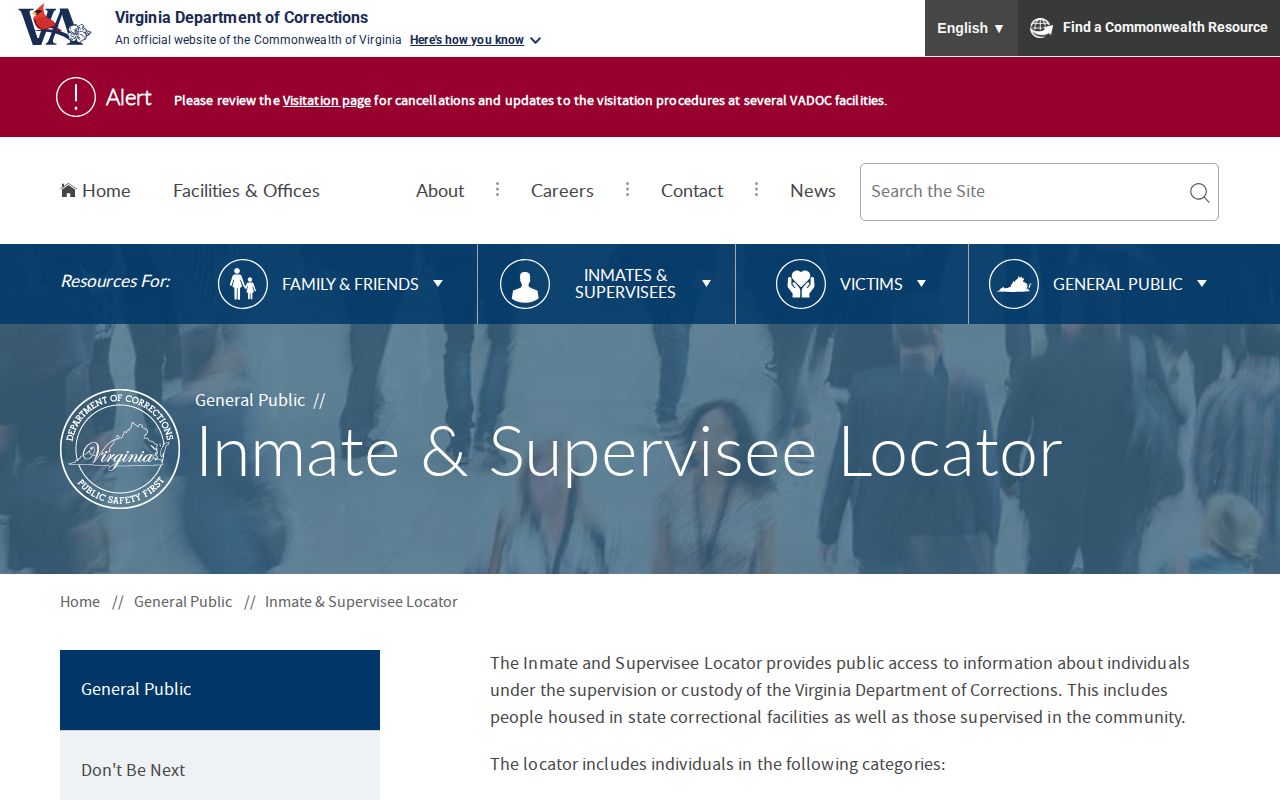
The result context determines whether the date is forward-looking in custody, while a district-office result indicates a different stage under community supervision.
Washington County Release Credit Systems
Virginia uses more than one sentence-credit framework. Good Conduct Allowance, or GCA, applies to the older sentence categories identified by VADOC, including felonies before January 1, 1995 and misdemeanors before July 1, 2008. When active GCA sentences total more than 12 months, VADOC calculates parole eligibility, mandatory-parole release, and good-time release dates. GCA classifications can range from no credit to 30 days for each 30 served under the governing rules.
Earned Sentence Credit, or ESC, generally covers felony sentences on or after January 1, 1995. Virginia Code §53.1-202.2 makes one earned credit equal one day deducted from the term. The offense lists and rate rules in §53.1-202.3 separate restricted subsection A offenses from eligible subsection B offenses. Classification and conduct still matter.
| Framework | Research-supported rule | Release-date effect |
|---|---|---|
| Older GCA sentences | Classes may accrue from 0 to 30 days per 30 served | VADOC applies the governing class and sentence structure |
| ESC restricted offenses | Maximum 4.5 days per 30 served | Credits reduce the adjusted active term at that statutory rate |
| Other eligible ESC offenses | Up to 15 days per 30 served | A higher possible rate applies only when the statute and classification permit it |
The statutes have extensive offense-specific and effective-date provisions. Use the version effective August 8, 2026, then match the person's offense and sentence. A general estimate cannot replace VADOC's computation. The VADOC time-computation source explains the agency's GCA and ESC roles.
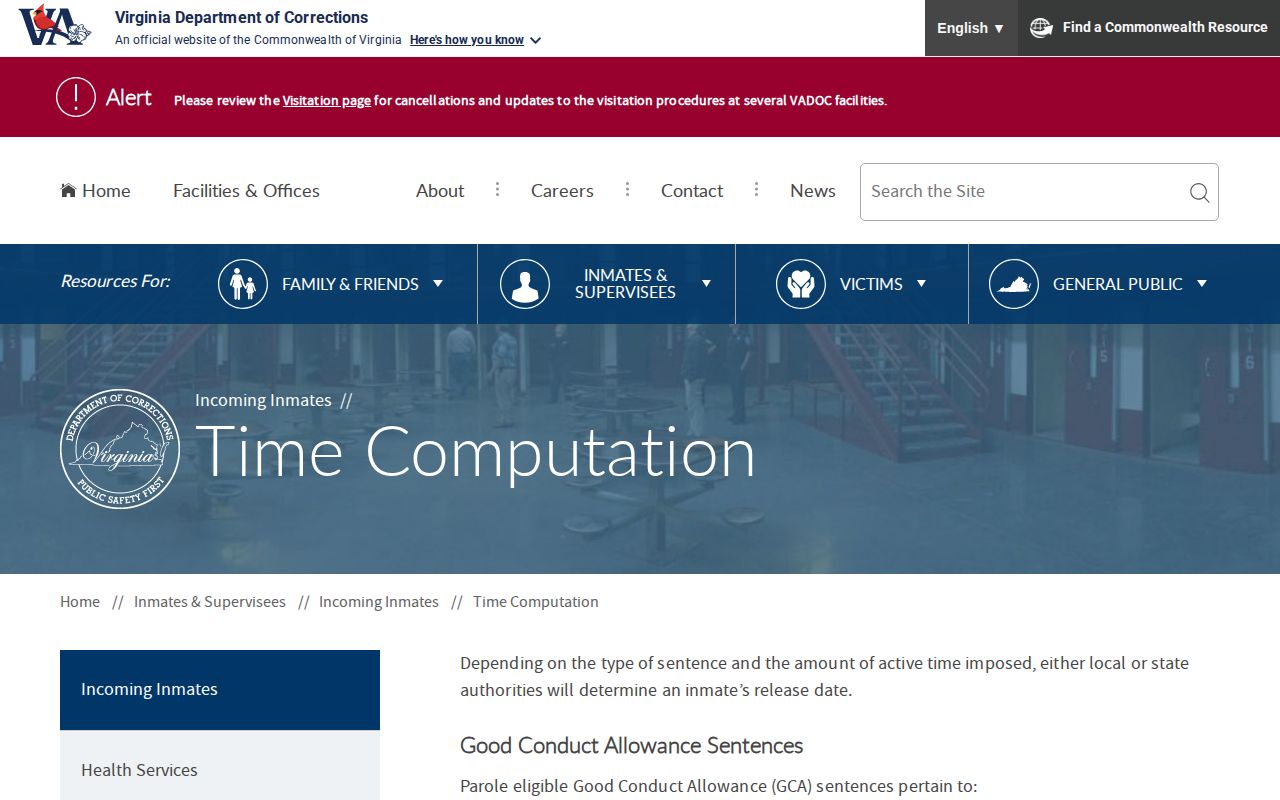
The state explanation shows why sentence type and active time must be known before a future Release Date can be interpreted.
Note: Credit eligibility, the maximum rate, and the amount actually earned are separate questions under Virginia sentence law.
Washington County Has No Universal 85% Rule
The claim that every Virginia prisoner serves exactly 85 percent is not supported. For subsection A offenses capped at 4.5 credits per 30 days served, dividing 30 by 34.5 yields about 86.96 percent of the adjusted term at the maximum rate. That is not 85 percent, and it does not apply as one statewide rate to every offense. Eligible subsection B offenses can earn as much as 15 days per 30.
Virginia's truth-in-sentencing framework combines earned credits with the general post-1995 parole limitation in §53.1-165.1. The parole statute contains exceptions. Credit statutes also depend on offense category and effective date. Therefore, calculate neither a Washington County release date nor a parole conclusion from an imposed term and a single percentage.
Section 53.1-202.4 addresses criteria and forfeiture. Credits can be lost through the lawful disciplinary process, and later restoration or correction may alter the projection. Court amendments and computation corrections can also matter. Only the responsible authority can apply all components to one record.
Changes to Washington County Release Dates
A projected date is a snapshot of the record then available. VADOC considers sentence type, active time, jail credit, credit-earning class, disciplinary forfeiture, and later legal events. Multiple sentences may run together or one after another. A corrected commitment order can change the calculation. A hold can change where the person goes even when one sentence ends.
| Factor | Possible effect | Best confirmation |
|---|---|---|
| Jail credit | Qualifying pre-DOC custody is applied to active time | Court order and VADOC computation |
| Credit class or conduct | Credits may accrue, be forfeited, or be corrected | VADOC time computation |
| Concurrent or consecutive terms | Sentence structure changes the combined end date | Certified sentencing orders |
| Amended court order | Active or suspended time may change | Washington Circuit Court and VADOC |
| Detainer or hold | Custody may continue under another authority | SWVRJA or VADOC plus receiving agency |
| Parole grant | Board action begins release-setting, not instant release | Board decision and later VADOC record |
Under the version of §53.1-136 effective August 8, 2026, VADOC sets release after notice of a parole grant, generally no sooner than 30 business days after receipt and subject to exceptions. A Board vote and a completed physical release remain distinct.
Washington County Jail Date Computation
No separate published SWVRJA county-jail good-time formula was found. No official weekend-release adjustment, release hour, or holiday-processing rule was located either. Those negative findings matter. A state-prison credit formula should not be transplanted to an Abingdon Facility booking simply because both are in Virginia.
For a local sentence, start with the Washington court judgment. Read active time, suspended time, time-served language, and jail credit. Then contact SWVRJA at 276-739-3520 for the recorded booking and release information. If an existing release transaction is needed, use the SWVRJA FOIA route and identify the name, booking or jacket number, dates, arresting agency, and case.
A sentence of 12 months or more can create a cross-system issue because VADOC may take legal custody and calculate time even if a person remains physically in a local jail. Some people serving under two years may remain physically local. Search both systems when that status is plausible. Physical place, legal custody, and the agency calculating time can differ without either record being wrong.
Note: Ask the jail and court about a local term rather than using the state ESC table as a county calculator.
Washington County Release Date Evidence
A reliable release-date statement names the agency, jurisdiction, source field, and access date. For a VADOC prisoner, capture the exact Release Date label with the search date and keep the surrounding warning that public data can be inaccurate or outdated. A later result may lawfully differ because VADOC received new sentence, credit, disciplinary, or court information.
Do not report the future date in the past tense. As the date approaches, compare the current locator result with the facility and any permitted VINE notice. If parole is involved, the Virginia Parole Board's monthly decision report shows the Board action, while VADOC controls release-setting after a grant. The Board's public-meetings calendar is an agency meeting schedule, not a person-by-person parole hearing calendar.
For an SWVRJA booking, a Release Date on a Released-mode row records the end of that displayed booking. It still must be read with Facility and Holds when community release matters. A receiving authority may have continued custody. For a court statement, use the actual disposition or certified order, then confirm physical custody separately. Court authority, jail processing, and a hold can each describe a different step.
Conflicts should remain visible until resolved. The final custodian transaction is strongest for the custody event, the certified court order controls the legal sentence, and VADOC is responsible for its state computation. A name alone is weak proof. Pair it with a booking number, case number, DOC ID, date of birth, or another compatible identifier before attributing the date.
Confirm Washington County Actual Release
Recheck the source close to the displayed date. For a state prisoner, compare VADOC's incarcerated result with any later district-office supervision result. For a local detainee, use SWVRJA Released mode and read Release Date, Facility, Cases, Charges, and Holds. A move to another authority site or a receiving agency is a transfer, not proof of community release.
VINE can add a notification lead where registration is available, but it does not replace the custodian. Jail VINE may use release-or-transfer language, and its registration does not move automatically into the separate VADOC service. The Washington County VINE inmate check explains how to choose the correct system and confirm an alert.
For an exact historical state computation issue, write VADOC, ATTN Correspondence Unit/Court & Legal Section, P.O. Box 26963, 6900 Atmore Drive, Richmond, VA 23261. For the legal sentence, request the certified order from the proper court clerk. For the custody event, obtain the final transaction from the custodian. Together, those records separate the sentence, projection, and actual release.